Derek was six years old when he made the mistake that would break his heart.
He was riding his bicycle in Mizoram, probably racing down a familiar path the way children do—fast, carefree, not looking far enough ahead. And before he could stop, he ran over his neighbor’s chicken.
The impact was immediate. The bird lay still. And Derek, understanding what he’d done, felt guilt crash over him with the weight of something much bigger than his small frame could carry.
Most six-year-olds would have run home crying. Would have hidden. Would have hoped no one noticed. But Derek did something different.
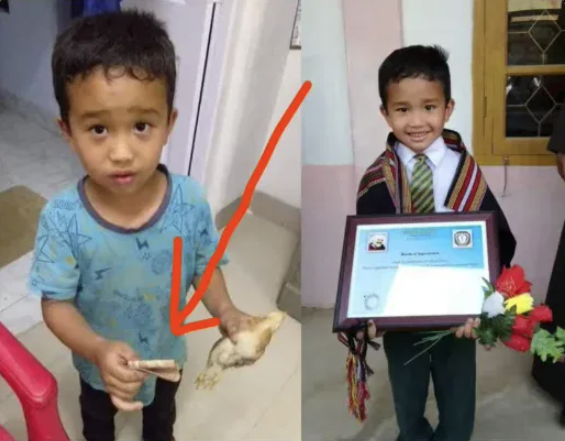
He picked up the chicken carefully, cradling it in one hand. In his other hand, he clutched his only ₹10—everything he had. And then he started walking to find help.
He went to doctors. Begged them to save the bird. A six-year-old child, holding a dead chicken and offering his entire savings, asking adults to fix what he’d broken.
The chicken had already passed. There was nothing anyone could do. But Derek’s innocence—his desperate belief that if he just found the right person, offered everything he had, maybe life could be restored—went viral.
His school heard the story. So did local organizations. And instead of dismissing it as a child’s misunderstanding of death, they honored what it represented: pure, uncomplicated compassion. The instinct to take responsibility. The willingness to give everything you have to try to make things right.
His school presented him with a certificate and a traditional Mizo shawl—a significant honor in the community. PETA named him a “Compassionate Kid,” recognizing that at six years old, Derek had demonstrated more empathy than many adults ever show.
The photos show the transformation: Derek on the left, holding the dead chicken and his ₹10, face solemn with guilt and hope. Derek on the right, dressed formally, smiling, holding his certificate and flowers, celebrated for the very quality that had made him suffer—his capacity to care deeply about a life he’d accidentally taken.
The story reminds us that true kindness lives in the smallest hearts. That children, before the world teaches them to be cynical or indifferent, often possess a purity of conscience adults have long since rationalized away.
Derek didn’t rationalize. Didn’t tell himself it was just a chicken, just an accident, not his problem. He felt responsible, so he tried to fix it. With everything he had. Which was one dead chicken, ₹10, and a heart big enough to believe that mattered.
The chicken couldn’t be saved. But Derek’s innocence, his compassion, his instinct to help rather than hide—those were preserved. Recognized. Celebrated by a community that understood they’d witnessed something rare.
Most people walk past suffering, telling themselves there’s nothing they can do. Derek ran over a chicken and spent his last ₹10 trying to bring it back to life.
The difference between those two responses is everything. And it’s a difference a six-year-old understood better than most adults ever will.
His story went viral not because he succeeded—he didn’t, the chicken was already gone. But because he tried. Because when faced with the consequence of his mistake, his first instinct wasn’t to hide or minimize or excuse.
It was to carry the bird in one hand, his money in the other, and beg someone to help him make it right.
That’s compassion. Pure. Unfiltered. The kind that exists before we learn to protect ourselves from caring too much.
Derek carried a dead chicken through the streets of Mizoram, offering ₹10 and hope to anyone who would listen.
And a community responded by saying: this matters. This kindness, even when it can’t change the outcome, matters. You matter.
Sometimes the smallest hearts hold the biggest lessons. And sometimes a six-year-old with a dead chicken and ₹10 teaches an entire community what compassion really means.